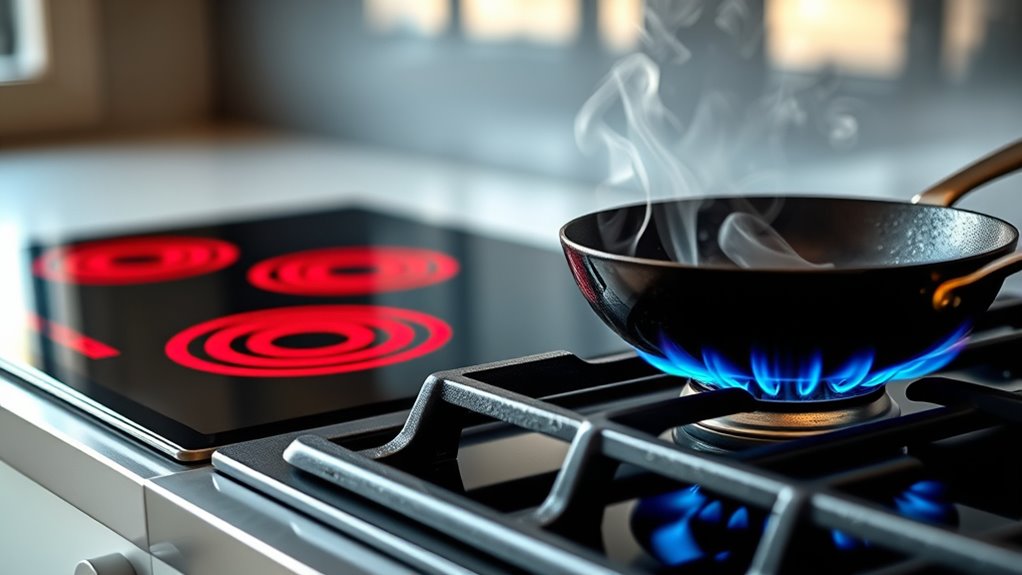
Induction Range Vs Gas: 3 Key Differences
Choosing between an induction range and gas can feel overwhelming, especially when you want fast cooking, precise control, and a safer kitchen. You’re not alone—many people struggle to decide which option fits their cookware, energy needs, and kitchen setup.
An induction range cooks faster, uses less energy, and offers greater safety than a gas range. You’ll boil water and adjust temperatures more quickly because induction heats compatible cookware directly, while gas first heats the grate and pan.
Induction converts more energy into cooking heat and produces no open flame or combustion gases. However, you’ll need magnetic cookware and suitable electrical service, whereas gas works with most pans.
Keep comparing these differences to find the best fit for your kitchen.
Key Takeaways
- Speed and control: Induction heats cookware faster and responds more precisely. Gas requires preheating the burner and pan.
- Energy efficiency: Induction transfers approximately 80–90% of energy to cookware. Gas typically transfers only 35–40%.
- Safety: Induction eliminates open flames and combustion gases. Gas requires careful ventilation and leak prevention.
- Cookware compatibility: Induction requires magnetic, flat-bottomed cookware. Gas works with nearly any pan.
- Installation and maintenance: Induction needs suitable electrical capacity and is easier to clean. Gas requires fuel lines, ventilation, and burner maintenance.
Induction Range Vs. Gas Range: Which Cooks Faster?
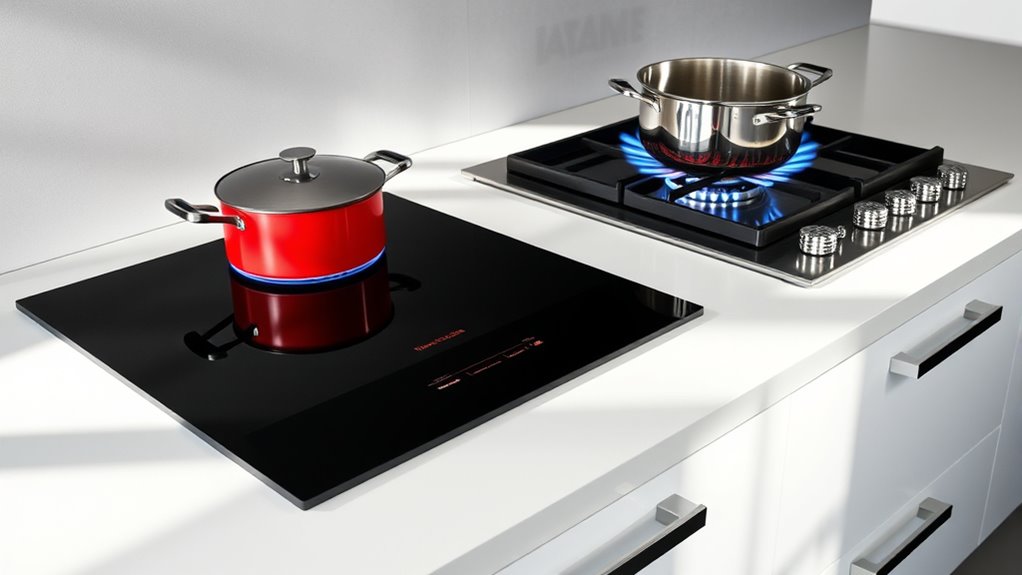
When it comes to speed, an induction range typically outperforms a gas range. You’ll notice this advantage when you boil water, sear meat, or bring a sauce to temperature.
Induction transfers energy directly into compatible cookware, so your pan heats almost immediately and responds quickly when you adjust the controls. Gas burners must heat the grate and pan before your food reaches the desired temperature, which can make preheating slower.
Induction heats compatible cookware almost instantly, while gas takes longer to heat the grate and pan.
Your cooking results also depend on pan size, burner output, and how well the cookware contacts the induction surface. Although gas delivers visible flames and familiar control, induction often gives you faster starts and more precise changes.
You’ll need compatible magnetic cookware, while gas works with nearly any pan.
Consider cooktop aesthetics and installation requirements, too. A sleek induction surface may complement a modern kitchen, but you’ll need the appropriate electrical connection.
Gas may require a fuel line and ventilation, factors that can affect your setup and cooking timeline.
Which Uses Less Energy: Induction or Gas?
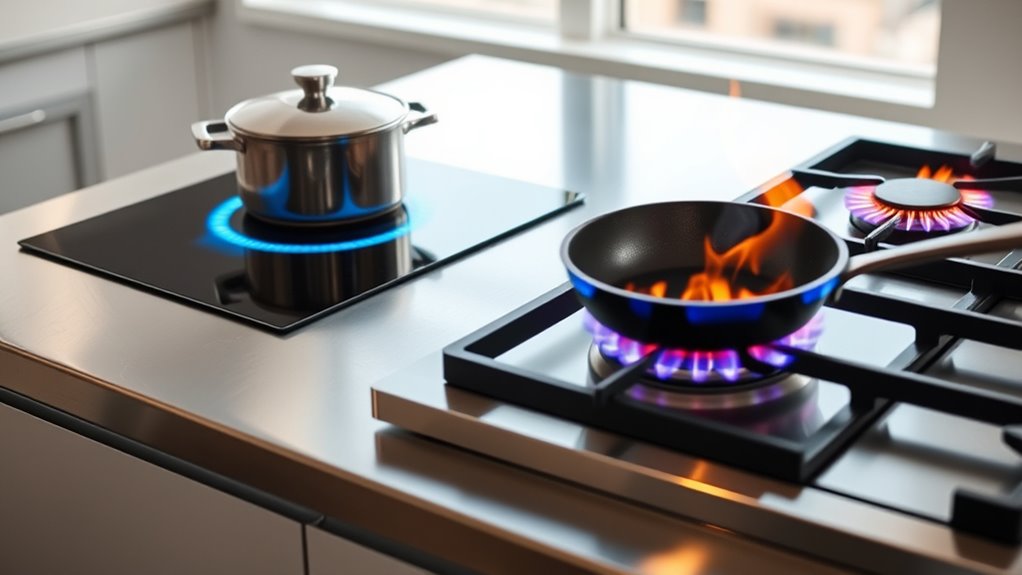
Induction ranges generally use less energy than gas ranges because they transfer more heat directly to your cookware. Electricity energizes the pan itself, while gas loses substantial heat around the sides and into your kitchen.
As a result, you can often reach cooking temperatures faster while using less total energy.
- Efficiency: Induction converts roughly 80–90% of its energy into cookware heat. Gas typically delivers about 35–40%, so more fuel goes to waste.
- Cost comparison: Your savings depend on local electricity and gas rates, cooking habits, and your range’s efficiency. Check your utility prices before choosing.
- Environmental impact: Induction may reduce household energy consumption, especially when powered by renewable electricity. Gas appliances burn fuel directly and produce indoor combustion emissions.
You’ll get the biggest benefit when you match pan sizes to cooking zones, cover pots, and turn settings down after reaching a simmer.
Although induction usually wins on efficiency, your home’s energy prices and electricity source determine the overall value.
Which Is Safer: Induction or Gas?
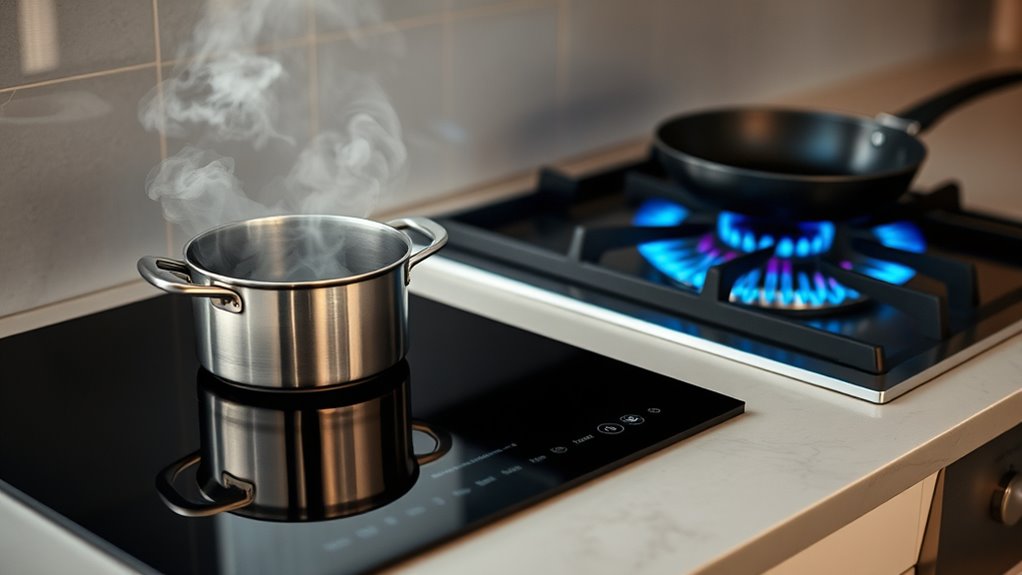
Which cooking surface keeps your home safer? For most households, induction offers stronger built-in protection than gas. Its surface stays relatively cool because electromagnetic energy heats compatible cookware directly, reducing burn risks from accidental contact.
Induction also produces no open flame, so you’ll face less risk of igniting towels, grease, or nearby cabinets. It doesn’t release combustion gases, which can improve indoor air quality.
Gas ranges can cook safely when you use them carefully. However, an open flame can cause fires, and a neglected burner may leak gas. You’ll need reliable ventilation and working carbon monoxide detectors, especially in smaller kitchens.
Modern models include valuable Safety features, such as automatic shutoff, flame-failure protection, and child locks, but you must use them correctly.
Your choice also affects maintenance requirements. Induction needs a smooth surface and compatible pans, while gas burners require regular cleaning to prevent clogged ports and uneven flames.
Frequently Asked Questions
How Does Induction Cooking Work Compared to Gas Cooking?
You cook with induction when an electromagnetic field directly heats compatible cookware, so the pan becomes the heat source while the surface stays relatively cool. With gas, you ignite fuel, and visible flames transfer heat to the pan and surrounding air.
Induction typically offers greater energy efficiency, faster temperature control, and easier cleanup. Your safety considerations include residual heat and cookware compatibility, while gas requires ventilation and careful flame management to prevent burns or leaks.
Do Induction Ranges Require Special Cookware?
Yes, you’ll need cookware with a magnetic base for an induction range. Cast iron, enameled cast iron, and many stainless-steel pans work well.
Aluminum, copper, glass, and nonmagnetic stainless steel won’t heat unless they include a compatible layer. To check compatibility, hold a magnet against the bottom; it should stick firmly.
For safety, avoid warped pans, lift rather than slide heavy cookware, and check that each pan matches the cooking zone.
How Difficult Are Induction and Gas Ranges to Clean?
Induction ranges are generally easier to clean because their smooth glass surfaces lack grates and burner caps. After cooking, let the surface cool, then wipe spills with a soft cloth and cleaner.
Gas ranges require more Cleaning frequency because food collects around burners, grates, and control knobs. You’ll face greater Maintenance challenges, including removing heavy grates and clearing burner ports.
Clean either range promptly to prevent baked-on residue and preserve performance.
What Installation Requirements Do Induction and Gas Ranges Have?
Before delivery day, think of installation like laying train tracks: a small misalignment can derail everything. For an induction range, you’ll need a properly grounded 240-volt circuit, suitable amperage, a level, ventilated space, and clearance above the cooktop.
For gas, you’ll need an approved gas line, shutoff valve, leak testing, ventilation, and often a 120-volt outlet. Follow local Safety regulations, confirm dimensions, and consider Energy efficiency when upgrading your electrical service or ventilation.
How Much Do Induction and Gas Ranges Typically Cost?
You’ll typically pay $1,000–$3,000 for an induction range and $700–$2,500 for a gas range, though premium models cost more.
Induction models often carry higher upfront prices, but you may recover some costs through energy efficiency and lower utility use.
Include installation, cookware, ventilation, and electrical or gas-line upgrades in your budget.
Safety considerations may also influence your choice: induction reduces open-flame risks, while gas may require additional ventilation and professional installation.
Conclusion
Choosing between an induction range and a gas range comes down to your priorities. You’ll cook faster and use energy more efficiently with induction, while gas gives you familiar, responsive flames and works during power outages.
Induction also keeps the surface cooler, making it safer to clean around. If you love the tactile feel of a flame, gas may still win your heart, but induction brings modern convenience worthy of a telegram from the future.
In conclusion, an induction range offers greater energy efficiency, faster cooking, and improved safety, while a gas range provides familiar flame control and reliability during power outages.